
Eventos
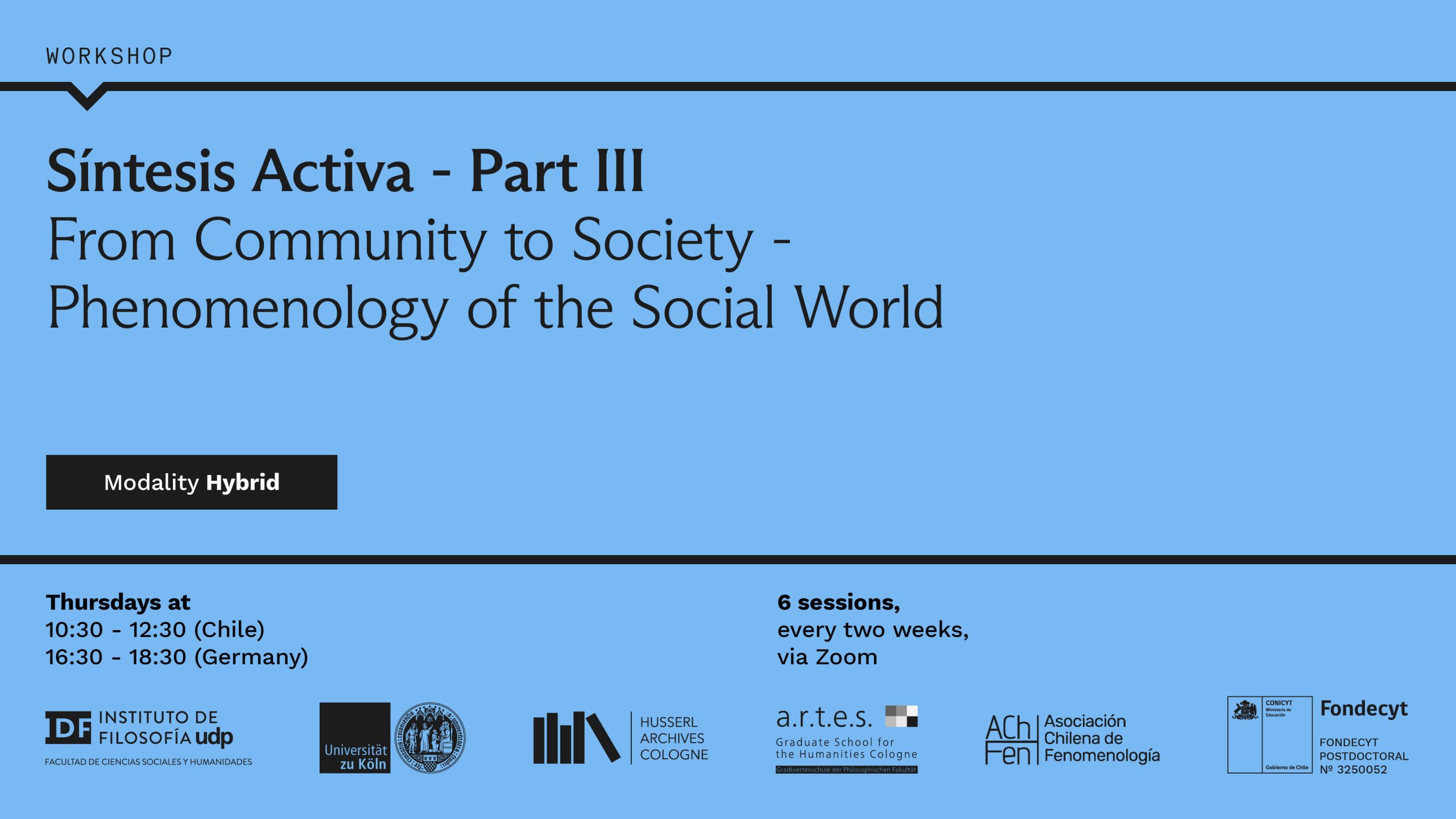
A collaborative project between the University of Cologne, the Husserl-Archives Cologne, a.r.t.e.s., the Chilean Association for Phenomenology, and the Diego Portales University
Early phenomenologists such as Max Scheler, Edith Stein, and Gerda Walther explored different levels of social experience by distinguishing between community and society. Husserl famously discussed the idea of humanity as a rational community, as well as its particularization into homeworlds and alien worlds. The reception of community and society in early phenomenology demonstrates the depth of phenomenology’s interest in the social world from its very beginnings. We take this as an opportunity to explore the many phenomenological approaches, from their roots to contemporary discourses, and to once again examine the diversity of social experience.
How can the different ways of experiencing the social world be described? Does the distinction between community and society still retain its phenomenological significance? Has the distinction between community and society been taken up within the French tradition, and how did French phenomenologists such as Emmanuel Lévinas, Maurice Merleau-Ponty, Simone de Beauvoir, and Jean-Paul Sartre elucidate the social world in their respective ways?
We further inquire into the ontology of social groups. How does phenomenology understand its constitution, and what makes me a member of a social group? We can also pose the question of the social world epistemically, based on the distinction between community and society. Does society imply a transparency and general intelligibility that makes it a privileged site for the exchange of knowledge and the formation of consensus? Is community, by contrast, a special place of familiarity and a special perspective on the social world that cannot be reduced to society?
Ultimately, engaging with community and society always has ethical and moral significance. Do my duties lie with the community or with humanity? How do these two ways of experiencing the social world shape my relationship with other persons and living beings?
We are looking forward to discussing these topics further at our hybrid seminar. The event can be attended in person at the Husserl Archives in Cologne or via Zoom. For details on the dates and speakers, see below. We are honored and delighted to welcome Prof. Dr. Dieter Lohmar and Dr. Celia Cabrera as the two keynote speakers of the event.
Modality: Hybrid
Thursday at 10:30 – 12:30 (Chile) and 16:30 – 18:30 (Germany); every two weeks via Zoom.
Registration link: https://zoom.us/meeting/register/JjS8GE5gTV-SUzbg9XwNlw
Session 1: 07.05.2026
Keynote speaker: Prof. Dr. Dieter Lohmar “Humanities and Basic Hermeneutics in Husserl’s Phenomenology”
Session 2: 21.05.2026
Paulina Morales “Towards an Experience of Sharing from a Merleaupontian Approach”
Raphael Röchter “The Solidarity of Life. Phenomenological and Metaphysical Perspectives in the Late Works of Max Scheler”
Session 3: 11.06.2026
Dr. Magdalena Pali Guíñez “Social Movement and Utopian Science: Political Implications of Husserl’s Ethics”
Philipp Battermann “From Empathy to Numbness? Husserl and the Pain of Others”
Session 4: 25.06.2026
Dr. Mauricio Troncoso “Cultural Sedimentation as Social Bond”
Carlos Anaya “On Pairing and Time in Husserl’s Cartesian Meditations and Related Texts”
Session 5: 02.07.2026
Rafael Stockebrand “Rootedness/lessness: Some Political Phenomenological Considerations»
Dr. Sara Dameno “’How Deep is Your Love?’ Stein’s Notion of Emotional Depth and Its Relevance for the Constitution of the Other Person”
Session 6: 16.07.2026
Keynote speaker: Prof. Dr. Celia Cabrera “Concordance and Self-realization. Husserl on the Ethical Task of Being True to Oneself»
Link de Inscripción